Wednesday, July 13, 2011

What Gauge Aluminum Is Best For Eavestroughs

There are basically 3 main thicknesses of aluminum that are used for eavestrough:

1. .023 of an inch which is most commonly used as it has the widest colour selection and can hold up to most residential applications. It is available in about 35 different colours from our supplier.

2. .027 of an inch which is slightly thicker than the .023 and is available in about 15 colours from our supplier.

3. 0.32 of an inch which is the thickest aluminum that our seamless machines can form. It is available in about 15 colours as well. This heavy gauge is commonly used for the larger 6 inch eavestrough but we have this coil slit down to fit in our 5 inch machines.

We can check the thickness of our heavy gauge .032 aluminum using a digital caliper as shown below:


Gauge aluminum thickness .023" .032" .027" Toronto gutter eavestrough

aluminum eavestroughing gutter installation Toronto North York Scabrorough

Any eavestrough company that works with a good supplier of aluminum will be able to provide all these thicknesses of aluminum coil. Our standard .023 gauge eavestrough is our most common thickness on most residential applications. We do recommend the .032 thickness for houses that have snow slides which often happen with slippery steel roofs. If you are thinking of getting a steel roof make sure you plan for snow guards all the way around the home if possible to keep the snow from sliding off and damaging your eavestroughs.

A very important factor for creating a strong eavestrough is to use a quality fastener (bracket) with a space between fasteners of no more then 24 inches. To make an eavestrough stronger simply install the brackets closer together like about 12 or 16 inches apart and there will be much more resistance to ice build up and ladder damage.

See a quality hanger with a large deep screw that will not come loose from the wood fascia:

Eavestrough installers bracket Scarborough Toronto North York

The standard .023 thickness is more than strong enough for most applications when installed properly. The cost to upgrade to the .032  heavy gauge eavestrough will add about 2 to 3 dollars per foot installed.

A great way to upgrade the strength of any gauge eavestrough is to add a leafguard/bracket system like the T-Rex. It comes in 8 foot long pieces and snaps into the eavestrough before the eavestroughs are secured on the home.
5" seamless aluminum eavestrough with AluRex TRex leafguard Toronto
Eavestrough leafguard long screws Toronto North York Scabrorough

Check out our video of us testing out our standard gauge .023 eavestrough and T-Rex leafguard on a Toronto home


Sunday, April 17, 2011

Mandatory Downspout Disconnect Due Dates City Of Toronto


Mandatory downspout disconnection toronto GTA

As most Toronto homeowners know (or have heard a bit about) there is a by-law to have downspouts removed from city drains. The city is focusing on the downtown area first because some of the sewer system there is called a combined system. This is where the water coming off your roof may mix with the sewage system. This is a major problem when we get a heavy downpour. The water treatment facilities become overloaded and dump raw sewage into the rivers and lake.Not great if you are one of those who like to swim in the lake in the summer. Anyone who cares for Toronto's water quality may be concerned as well. The deadline for this area is November 20, 2011


Second in priority is an area from about Steeles Ave down to Eglinton Ave, including most of North York. (Check link to map below as this is approximate.) This area has a newer system and is not considered a combined system but still has problems in dealing with all the roof water being added to the storm sewer system. Problems are encountered during heavy rains. The volume is too much and they become overloaded causing the water to back up into your basement. All this water off your roof also concentrates in the creeks and streams causing flooding and erosion. The deadline for this area is December 3, 2013.

Program experts with the City of Toronto can be reached at 416 392 1807 to help clarify any questions you have.


The remainder of the Toronto needs to be disconnected by December 3, 2016, including parts most of Scarborough and Etobicoke.


Key points to make the process easier:

1. Not every downpipe will have to be removed from the drains. The city of Toronto does not expect to have every downpipe removed. You must determine if the property is graded properly to drain water away from your home. Keep in mind that the water must not flow towards the neighbours and create a problem for them either. (If having waterproofing work done on the exterior of your home, do not allow the contractor to remove any of the drains unless there is a plan to relocate the downpipe or allow the water to safely flow away from your home.)

2. Keep water back from sidewalks.

3. If the downpipe cannot drain safely onto the ground in the position it is in then, you must look at the possibility of moving it to another location if feasible. This can sometimes require extensive regrading or replacing of the eavestrough (depending on age of the system).

4. Enlisting the help of an eavestrough/gutter professional will help clarify what is possible and what is not.

5. Some downpipe disconnects require not much more than a few simple tools, an elbow and a piece of    downpipe. These are easy for just about anybody to do. We have posted a video below for those who want to do this project themselves. We also provide a link to Toronto's do it yourself guidelines below.

6. If a downpipe is in a poor location it is sometimes possible to delete it completely by using larger downpipes to handle the extra flow and proper grading of the eavestrough to a new location.

7. The homeowner and knowledgeable contractor must determine which downpipes can be safely disconnected. If there seems to be no solution then the homeowner must apply for an exemption.

8. For downpipes that cross walkways consider digging under walkways using 4 inch PVC pipe so that there is no downpipe extension to get in the way. If the property slopes away from the home quickly then this is very easy to do. If the property is more flat then a pop up drain system may be more suitable. The only drawback of this system is that the underground pipes usually stay full of ice in the winter.

9. Draining water onto driveways is not a great alternative for improving the city's water quality as the water just flows out to the street and into a storm drain. This defeats the purpose of the disconnect and can be icy in the winter.

10. It's a great time to think about taking things one step farther and incorporating a rain barrel into your eavestrough system and harvest some of that water for a later time. If hooking up a barrel you will need to add a Y diverter so the barrel can be removed in winter and also redirect the water when the barrel is full. Rain barrels fill very quickly so do not depend on them to contain all the water from a downpipe.

11. Poor grading around your home that can be fixed by filling sunken areas with clay will help get the water away properly. You are expected to do this if it means that the downpipe can be disconnected properly.

12. If unsure of the grading/slope of your ground around your home you can test an area before disconnecting your pipe. Simply turn your garden hose on and let it run for awhile where you plan to put your new downspout. Within a half hour of running the hose you will see where the water is going to go and make decisions based on this information.

13. Built up flower beds around homes are usually not good areas to drain water if there are retaining walls. The walls often hold the water too close to the home plus the water can cause damage to the walls.


Helpful links and videos:


Here is the link to the new upgraded map on Toronto's website which will make it easy to see when your deadline is to have your downspouts disconnected.
http://www.toronto.ca/water/protecting_quality/mandatory_downspout_disconnection.htm

Link to apply for an exemption: http://www.toronto.ca/water/protecting_quality/mandatory_downspout_disconnection_exemption.htm


Here is a video we put together to assist you in disconnecting your downspouts yourself. It is quite easy to do and will do wonders for the water quality in Toronto and often reduce the chance of leaks in your basement, if done properly. It is about 7 minutes long so may only be interested if you want some technical information. Here is our YouTube link to this video as I can never get it to fit as good into this blog as it should. http://youtu.be/BNJ0mH4_M9M


Here is the link to the how-to guide put out by the city of Toronto.
http://www.toronto.ca/water/protecting_quality/downspout_diy.htm

Here is a link for a not for profit company called Riversides based out of downtown Toronto. They have been instrumental in educating homeowners on the benefits of water conservation and storm water management. You can purchase a rain barrel from them and have it delivered in the downtown. They also have good tips to consider.
http://www.riversides.org/rainguide/riversides_hgr.php?cat=2&page=39&subpage=41


Your local hardware stores may have some of the basic size downspouts and colors that you need to do the job yourself. If you need more specialized sizes or colors there is a retail store at Victoria Park and Danforth called Danforth Roofing. We have featured them in a previous blog post:
http://torontoeavestroughing.blogspot.com/2010/09/where-to-find-quality-eavestrough-parts.html


Homeowners in the GTA have an opportunity to make a big difference in the quality of the Lake Ontario and watersheds that lead to the Lake. This can be accomplished just by draining or saving your rainwater on your property.

This whole downspout disconnect can seem like a real pain but in many instances getting your downspouts out of the old clay drains around your home might save you lots of trouble with leaks into your basement as they crack and shift and often dump water right along your foundation without you knowing! Out of sight and out of mind can really hurt the wallet down the road when you have to excavate the side of your home to water proof or fix mold problems in your damp basement.


Visit our website http://www.eavestough.ca/ or call our office at 416 615 0443. North Shore Eavestroughing are experts at installing new eavestrough and leafguard systems to protect your home, maximize water flow onto your property and keep it out of the Toronto's storm sewers. We have a $575.00 minimum charge for small projects. Sorry but we so not serve south of Eglinton in the downtown core but hope this information will be helpful for you if you live downtown.

Visit our Google Place page http://g.co/maps/t9xqc

Monday, April 4, 2011

Window Wells Can Cause Basement Flooding


Tips:

1. Keep all downspouts as far away as possible from window wells when designing your new eavestrough system.

2. If a downspout is close to a window well ensure it is fastened together very secure so that it can not fall apart and fill the well with water.

3. If you suspect that there is not proper drainage at the bottom of the well consult a basement waterproofing company to inspect. There should be a drain at the bottom to take water away so it does not enter your basement.

As shown in the picture below, the downspout drains near the window well. It's very likely that water flows into this window well from this downspout. This window well is in obvious need of attention. A temporary fix would be to add a long extention on the elbow to get the water farther from the basement window.

Have a home in Scarborough, North York or other areas in or near Toronto and need help with rainwater management? Visit http://www.eavestrough.ca/ or call us at 416 615 0443 for a free estimate for your eavestrough and leafguard project. We are experts in Toronto eavestrough.

Saturday, March 5, 2011

What Size Eavestrough Do I Need on my GTA home?


One of the most popular questions asked when considering a new eavestrough system is which size is appropriate for my home.

The most common size today is 5 inch wide. This will take care of most all residential applications with just a few exceptions.

1. These would include a very large shingle or roof overhang that causes the water to shoot over the top of the eavestrough. This is usually only seen on a clay tile roof where the bottom row of stone tile hangs way out past the fascia.

2. A large roof area flows into a short length of eavestrough. Usually this is in an inside valley area where the flow of water is concentrated.


Six inch eavestrough can handle a higher volume of water because it is not only wider but also deeper. This is good for water flow but does not fit well on homes that have a regular 6 inch wide fascia. The 6 inch eavestrough ends up hanging off the fascia as it is angled down to the downspout and can look unsightly.


Larger 6 inch eavestroughs are generally reserved for commercial applications which normally have at least a 8 inch wide fascia board.


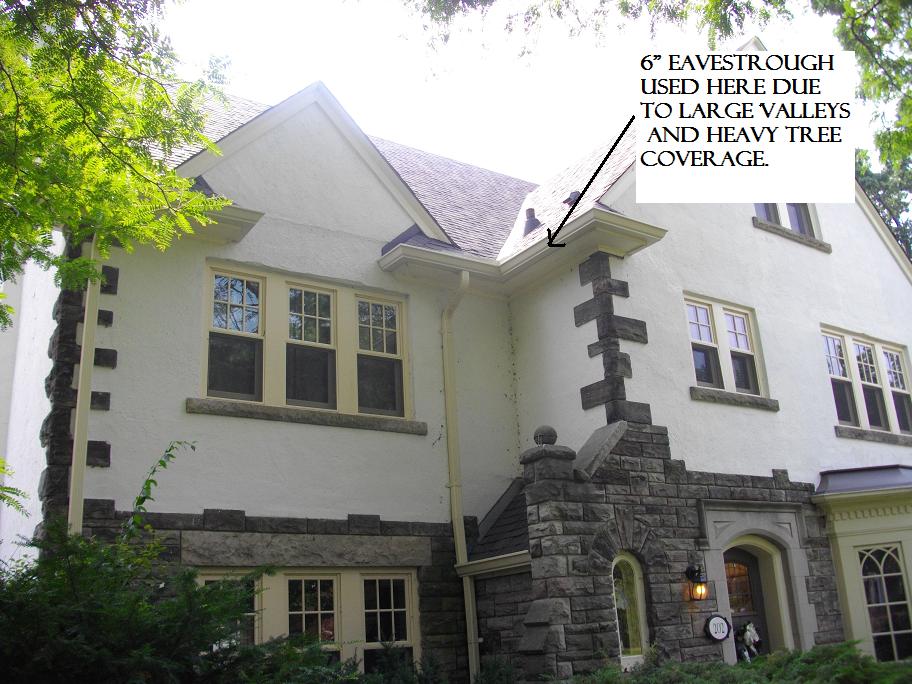
The above picture of a Toronto Home shows an example of a large roof area/valley flowing into a 6 inch eavestrough. 6 inch was used here to help ensure that there will be no water bypassing the eavestrough. Its extra challenging to contain all the water in a area like this because of the speed the water shoots off the inside valley. Because we almost always use leafguard this adds to the challenge. The extra wide eavestrough here helps give more surface area to the leafguard allowing the water to drain faster. Even with the larger eavestrough proper valley splash guards must be used to prevent overflows. Another trick, is to drill slightly larger holes in the T-Rex to allow for better drainage.

The biggest mistake in the book is to install 6 inch eavestrough but not use at least a large 3x4 downpipe. Using a 3x3 downpipe on a eavestrough this size is a waste of capacity.

A properly sloped 5 inch eavestrough with the same large 3x4 pipes installed will drain the exact same amount of water as a 6 inch eavestrough.

The advantage of using a 6 inch eavestrough is that the downpipe size can be upgraded to a 4x5 inch downpipe which will really make sense with such a big eavestrough. However most people will not like the look of these huge commercial downpipes on their home.

In summary 6 inch is generally only required for commercial purposes where the size is proportionate and the downpipes can be upgraded to 4"x5" without looking out of place.

Visit our website at http://www.eavestrough.ca/ Also check out our YouTube channel www.youtube.com/torontoeavestrough where we have almost 50 videos on eavestrough and leafguard.

Saturday, February 12, 2011

8 Ways To Combat Ice Dams on a Toronto home

It's very important to understand that the ice build up shown below is usually the result of a heat loss problem in the attic. The heat loss through the ceiling and lack of proper ventilation need to be addressed.

Never let anyone tell you that installing new eavestroughs will have a significant impact on any ice issues you may experience with your home. A proper functioning eavestrough system is definitely an important part of the big picture that may help with this problem but new eavestroughs will not eliminate ice build up, if the heat loss problem isn't taken care of.


Properly functioning eavestrough is essential for proper rainwater management around your home. In a Toronto winter we are dealing with snow melting due to heat loss and that is a different story. Snow melting on the roof will refreeze on the roof edge and eavestrough no matter what condition it is in because of below zero temperatures.

Ways to combat ice:

1. Prevent heat escape through the ceiling by making sure there are no major gaps around light fixtures to let warm air into the attic. This is best done from the attic and is easy to see once the loose fill insulation is pulled back a bit. Use spray foam to seal any gaps.

2. Make sure the insulation is about 16 inches thick to provide about an R-50 insulation value. Ensure it's evenly spread and no bare spots which are often caused by people working in the attic to do electrical and not spreading the insulation back out properly after the work is completed. If you have old style potlights, have an electrician inspect them to make sure they are to code before covering over.

3. Ensure all bathroom vents actually vent directly outside the attic through the roof and not just laid into the soffit.

4. Visually inspect from the attic that the soffits on the home are actually providing fresh cold air. You should be able to see a clear path to the soffit in the form of a baffle attached to the underside of the roof. Often you can see daylight if their is a clear path to a vented soffit. If you plan on getting your attic blown in, ensure baffles are installed if needed to ensure the ventilation to the soffit is not compromised.

5. Ensure that there are enough vents at the peak of your roof to let any heat out.

6. Install heater cables on the roof edge , eavestrough and down pipe. Note that this will not deal with the root cause of the ice. This is just throwing more energy at a energy loss issue. However careful use is needed in some cases. Some houses would require a major renovation to get to the root cause of heat loss due to vaulted ceilings etc.

7. Remove the snow off the roof so it can not melt and cause problems. Some roof tops can be reached from the ground using a roof snow rake which is much safer then going up a ladder this time of year.

8. Inspect soffits from the exterior to ensure that most or better yet all of the soffits are perforated with little holes to let the attic breathe. Unfortunately many homes have a layer of plywood hidden under the aluminum soffit which ideally should be removed to allow for maximum ventilation. To determine this a piece of soffit will need to be partially removed to inspect. Most Toronto and GTA homes built before the 80s will have this plywood. It's there because wood was used to cover in the soffits back then, not aluminum. When the aluminum soffits were done at a later point to cover the old plywood, the installers normally did not remove it to save time. At the very least, make sure there is a 1 foot square hole cut in the old plywood every 8 feet. Every piece of new soffit should be perforated.

Are you interested in new eavestroughs, leafguard, soffit, fascia, insulation or LED lighting for your Scarborough, North York or Toronto home?  Visit our website at www.eavestrough.ca

Stripes On Gutters

These stripes seen on this eavestrough are called tiger stripes. They are normal on light colored eavestrough. White shows up the stripes the most of course.

These are caused by dirt that sits on the top edge of the eavestrough. The dirt gets washed over the front with the rain.


We have solutions for this if it is imperative that you never want to see tiger stripes. We have can use an upgraded version of the T-Rex which has a built in drip edge.

The picture shown is an example of how they can be cleaned off with great results. The key thing is to make sure it is not left too long or the dirt will stain the finish on the gutter. This gutter was almost 2 years old and cleaned up nicely.

The cleaner we used was Spray Nine which is a multi-purpose cleaner an can be found at Canadian Tire in Toronto.

Interested in a quote for eavestroughs or leafguard in Scaborough, North York or other areas in and near Toronto? Visit our site at www.eavestrough.ca

Tuesday, January 25, 2011

Working At Heights Safely in the GTA

Every year in Ontario people fall while performing work at heights. Fortunately, there are preventative measures that can be taken to protect workers who are at risk. Ropes and harnesses are required by law for anyone working over 10 feet high.

Inspectors are few and far between so the onus is on the companies to conduct themselves safely.

Toronto Homeowners can do their part by hiring companies that work safely. Don't be afraid to tell the contractor you are hiring that you expect safety on your property.

Knowing what the law is and how it can keep workers safe at heights really makes it hard to turn a blind eye. Some high risk activities are roofing, eavestroughing, painting, and window and eavestrough cleaning.

Reduce your liability and hire smart. You may save a life!


Visit our website at www.eavestrough.ca

Sunday, January 23, 2011

Why Do Downspouts Fill With Ice?

Iced up downspouts are often cause for concern. You may wonder if the ice is blocking the downspouts due to a blockage of some sort. While this can be a factor in some cases it's more than likely just frozen water. The snow on the roof melts off the roof due to heat loss through the attic. The melted snow then runs down into the downspout which is not heated by the roof or in direct sunlight. The water instantly turns back to ice creating an ice filled downspout.


Adding more downspout or larger downspouts are not effective strategies for solving this problem. They will ice up just the same as the problem downpipe. If you really want to solve this you have to go to the root cause which is generally a heat loss issue in the attic. If fixing the insulation or ventilation in the attic is not feasible due to money or logistic reasons then a heater cable traced down the pipe can be very effective to keep your pipes free of ice.


Here is a quick video of a Toronto home with no ice issues. The pipe stays free of ice and snow.


Visit our website at www.eavestrough.ca

Tuesday, November 9, 2010

We Are Booking Up Fast!

It's important to have all the necessary equipment in order to complete your eavestroughs safely and efficiently. A neighbor pondered at all our ladders and was quick to mention that it looked like we were holding up the side of this house. Lots of ladders make the job much easier for our installers and are made of fiberglass instead of aluminum for safety around power lines.

The first half of November has been great working weather in Toronto. The phones have been busy as homeowners realize winter may be just around the corner. We still have some openings before winter sets in. We work all winter long so not to worry if you book your project late. There is no sacrifice in quality by doing your eavestroughs in the winter. We can often give winter discounts for those who are ok with waiting until our season settles down. Just let us know when we come to estimate so we can price it both ways.
If you have a home in Scarborough, North York or another area of in or near Toronto and are interested visit http://www.eavestrough.ca/ or call us at 416.615.0443 for a free estimate.

Monday, November 8, 2010

Warm White LED Soffit Lighting in the GTA

Today we completed another soffit, fascia, eavestrough and LED light project, in Scarborough. I want to show a couple of pictures of the end result. The lighting project consisted of only four recessed LED lights but had a big effect. It really created that wow factor in terms of curb appeal. Installing new eavestroughs and/or soffit and fascia is the perfect time to install a low voltage light system.


LED soffit lighting eavestroughs low voltage
LED soffit recessed lighting low voltage Toronto North York Scarborough LED pot lights vary in cost from about $200.00 to $300.00 per light installed depending on the quantity and level of difficulty.

Visit www.eavestrough.ca or call our office at 416.615.0443. for free estimate.


We provide a full Exterior LED Lighting service when you have us do your eavestrough work in Scarborough, North York and other areas in and near Toronto.  If you want to purchase the LED product to install yourself directly, go to www.delphitech.com and check out there online store.

Friday, October 22, 2010

How To Install LED Soffit Lighting

We have been getting a lot of interest, from around Scarborough and Toronto as well as farther away  about our LED soffit lighting and thought it would be good to put up another post which gives more information about them.

The new generation of recessed lights are warmer in colour making the longevity and energy efficiency of LEDs even more appealing.

At about $200.00 to $300.00 per light installed, the lights are not for the price sensitive but are great for the Toronto homeowner who plans on staying in their home for awhile. They are perfect for highlighting an entrance and or security lighting.

With a life expectancy of 20 years plus (100,000 hours), there will be many years to appreciate the unique look, flexibility of placement and energy savings.

If you are handy and can do the installation yourself then here is a direct link to the manufacturer as we supply and install only.  www.delphitech.com

A video for you to see how we easily install a LED recessed / pot light into an existing aluminum soffit:


A video of how we make the connections:


This Toronto video shows how to decide where to place the lights at an entrance area and also how to run wire in the existing soffits:


A video of how we configure the power source and automatic timer. The best location is in a garage or in a utility room. All that is required is a spare outlet that we can plug this unit in to.


We do installations here in the Toronto area. Visit our website at http://www.eavestrough.ca/

Sunday, October 10, 2010

North Shore Eavestroughing at the Home Show with Jay Purvis of the HGTV show The Fix

Eavestrough leafguard downspouts Toronto Recently we were invited to a Home Show to speak with a panel of experts to give advice to homeowners on renovation dos and don'ts.

It was hosted by Jay Purvis of the HGTV show The Fix
http://www.generalpurposepictures.com/thefix/meet.html

We were happy to speak on the importance of a proper functioning eavestrough and leafguard system on your home. We gave tips and advice on how to prepare your gutters for the winter season.

North Shore Eavestroughing works in Scarborough, North York and other areas in and near Toronto.
Visit www.eavestrough.ca for more information or to contact a rain water management professional.

Sunday, October 3, 2010

Onstage Connecting With Clients Event Hamilton

Small Business owners North Shore Eavestroughing Toronto This weekend North Shore Eavestroughing was invited to speak to small business owners at the Hamilton Ideal Home Show. It was an excellent opportunity to share the basics of social media to small business in Hamilton. It was a great success and we were thrilled to share the stage with media experts and contractors who are embracing social media.
(from left to right):

Tom Whitaker of Tiny Briefcase. A company who helps small business use technology to improve their business. www.tinybriefcase.com

Myself, Darren Perry of North Shore Eavestroughing of Toronto www.eavestrough.ca

Andrew Goodman, President of Page Zero Media and author of best selling book Winning Results with Google AdWords. A true expert on online pay per click campaigns. www.pagezero.com

Chris Healy also representing Tiny Briefcase.

Jerret Jastal of Stonecoat. An expert in resurfacing concrete outside and everything inside. www.texturock.com

Jeff Schnurr of Toronto Home Theater and Inview Marketing. www.inviewmarketing.ca

Definitely a great group of people and I highly recommend contacting them if you think they might be able to solve any of your problems.

Monday, September 20, 2010

Where to find quality eavestrough parts.

eavestrough downpipes materials Toronto


We often get calls to our office asking if we can retail eavestrough parts like downpipes etc. Since we are primarily a supply and install company we thought we would give a great contact if you were looking for quality parts and may just want to do a repair yourself.

Danforth Roofing is located at 3145 Danforth Ave near Victoria Park and Danforth Ave., Toronto

Their phone number is 416 699 7127.


Danforth Roofing also has a metal bending shop that can custom bend any flashings etc that you might need. Wayne and the crew always give excellent service in the back shop.


Tara is always professional and ready to look after customers at the front desk.


They have different colours and accessories for downpipes. They also make Y diverters if you plan on installing a rain barrel and want to have control over the water. With a Y diverter you can divert the water out the downspout when the barrel is full.

Danforth Roofing has been offering us excellent service over the years, making Y diverters we need for installing barrels. Danforth gives homeowners the chance to purchase eavestrough accessories that are of better quality than what they would find at the local hardware store.

If you are in Scarborough, North York, other areas in or near Toronto and need a full service company contact North Shore Eavestroughing for a free estimate.
Our website: http://www.eavestrough.ca/
Our email: info@eavestrough.ca