Monday, April 8, 2013

Bullfrog Powered

We are proud to say that we have been powered by green electricity since 2009. Bullfrog power allows businesses and homeowners to utilize green energy.


Like many people we are very concerned about how we can lessen our impact on the environment. For a minimal monthly increase in our electricity bill we can ensure that all our energy consumption gets put back into the grid by means of green energy from sources like wind, solar and hydro electric. 


North Shore Eavestroughing replaces and repairs eavestroughs, leafguard and other aspect of rainwater management in Scarborough, North York and other areas in and near Toronto

Visit Bullfrog Power's website: http://www.bullfrogpower.com/

Friday, April 5, 2013

Clean Outs For Pine Needles

We recommend the use of clean outs when installing the T-Rex leaf guard in an area that has pine needles. Pine needles are long and slender and a few do make it through the small round holes in the leaf guard. Only a small percentage go through and the vast majority stay out of the eavestrough.

The T-Rex is not removable so clean outs are important in some cases.

In 10 years we only had one person contact us because there was a blockage under the leaf guard. Since then we have added trap doors over the downspouts to allow access to any needles that may get caught up in the outlet. This way, in the rare event a blockage occurs, there is an easy way to remove the debris.

This is how we create a trap door in the T-Rex:

First off, we leave a space over the down pipe outlet. We do this by leaving a 6 inch gap between two sections of T-Rex. I should mention that we can install clean outs over any section of the leaf guard for minimal cost. Most likely they will never be needed but you can have peace of mind knowing that they are there. Also there is access to under the leaf guard where there is a corner as there are corner covers which are easy to remove.

eavestrough with cleanout


This will give easy access to any debris caught at the outlet. 

eavestrough outlet


Then we take a slightly different version of the T-Rex call Gutter Clean and cut it at about 10 inches so it will completely cover the gap.

T-Rex Gutter clean leafguard


It fits perfectly and is screwed down with 2 screws so it is secure.

cleanout installed on leafguard


Now for a demonstration of why trap doors come in handy when there are pine trees next to your home.

Pine needles like the ones below can get through the small holes.


If the pine tree is hanging over the home then you can expect to see a build up of pine needles
on the leaf guard. Even with this much sitting on top the rain water can easily pass through as these needles are very coarse. With a good wind some will blow off. You may still have to have someone do a brush off the top every fall. This is still much easier then scooping out a full, plugged downspout and eavestrough. This T-Rex leaf guard will drastically reduce the frequency of cleaning, if you have a full tree canopy. If the trees are back slightly from the home then you may not have to clean at all as the wind will blow most debris off.


A cross section view of a few pine needles getting through the T-Rex

cross section of eavestrough and leafguard


Its possible after many years to get a blockage because the pine needles have clogged the top of the pipe. All debris flows along the bottom of the eavestrough and ends up at the downspout. Alu-Rex, the makers of the T-Rex require a minimum downspout size of 9 square inches which is a standard 3x3 inch downspout for warranty in a pine tree area. Alu-Rex is an excellent company and will follow up on any warranty claims.  If you have a blockage and you have 3x3 pipes they will come out and clean the outlet! Alu-Rex has a 40 year warranty on the product and performance of the product.
In this blog post we show a 3x4 inch outlet.


Spruce needles are of course much shorter and do not cause a problem. The few that make it through the small T-Rex holes will easily wash out the downpipes. They are not long enough to get hung up at the top of the downspout. The same applies to shingle grits. They will wash out in the heavy rain.


Spruce needles will never cause a blockage of the downspout because they are so small they will never block an outlet. They easily flow out the downspouts.


Clean outs will be a good choice with any leaf guard that has any hole large enough to let a pine needle in. That applies to the hooded type leaf guards like K-Guard as when the water wraps around the nose due to surface tension, some debris gets pulled in as well.

The old style mesh products we used to install 15 years ago (because there was no better option on the market) had holes that were too large and let way to much debris in. Eventually someone would have to clean underneath them. This leaf guard is responsible for giving leaf guard a bad rap when in fact the new versions work so much better.


Below is a side by side comparison of the Alu-Rex Gutter Clean and the Smart Screen. Smart Screen on the left has much larger holes then the Gutter Clean. Bigger holes may allow more pine needles to go in so clean outs will be a good idea with this product as well.

leafguard comparison in Toronto


Products like the Leaf Solution on the left and Rhino Guard on the right will keep all shingle grit and needles out of the eavestrough but they come with a significant extra cost as compared to the T-Rex. These products have a fine mesh over a aluminum frame which keeps everything but the water out.
The T-Rex is by far our most popular product with our clients and gives excellent value as it costs much less than most leaf guards on the market.


The T-Rex costs an extra $3.00 per linear foot when you are getting new eavestroughs. Compare that to many other kinds that cost $9.00 to $12.00 and the choice will be easy for most.

North Shore Eavestroughing services Scarborough, North York and many other areas in and around Toronto.

Visit out website www.eavestrough.ca or call us at 416 615 0443 for a free, no obligation estimate in the Toronto area.

Friday, March 29, 2013

Professional Lettered Equipment

We never get a second chance to make a first impression. North Shore Eavestroughing believes that we must portray an image that is consistant with the high standards we have for working on your home. Clean, well lettered vehicles can be one way to determine how much pride a company takes in their day to day operations. Companies that take pride in their work and operate without subcontractors generally have well lettered company vehicles. This is a great way to pre-qualify potential contractors no matter what the trade.


We work in Scarborough, North York and many other areas in and around Toronto, year round. Call us for a quote today! Visit our website www.eavestrough.ca or call 416 615 0443 for a free no obligation quote on your eavestroughing needs.


Sunday, March 24, 2013

Attic Insulating In Toronto

Many homes around Toronto have attic spaces are not ventilated or insulated properly. This can result in a roof not lasting as long as it should, high heating and cooling costs, mold, and ice damming.

We would like to give an overview of how we have overcome some of these issues for our clients.

First off, if your home has wood soffits then sections of the wood soffit should be cut out to increase airflow. For this client we are cutting out all the plywood soffit to maximize airflow into the attic. Keep in mind that this layer of plywood can be hidden under a layer of existing soffits.

With the installation of new aluminum soffits the plywood can be completely removed with out jeopardizing the integrity of the roof. The plywood was used many years ago to seal up this area but today aluminum soffits will take its place and vent much more effectively. New homes today do not have a layer of plywood, just aluminum or vinyl soffits.


Cutting out all the plywood is more labour intensive than just cutting an extra ventilation holes every so often. It does however let the attic breathe much better. Also removing the plywood at this home allows us to see some pot light wires that were chewed bare by squirrels. This resulted in a service call from our licensed electrician to correct the hazards.


It takes about a 1/2 to full day to cut out all the plywood on a typical Toronto home. The clean up is intensive as usually there is much debris sitting on top the old plywood. This is where hiring a thorough soffit, fascia and eavestrough company pays off because they are knowledgeable and care about the aesthetics and very importantly, the function of your new system.


Now that the plywood is out we look up into the cavity to see how many rafter vents have been installed if any. They are a simple foam chute that is stapled to the underside of the roof deck. They are needed to prevent any insulation in the attic from coming out onto the soffits and also to allow an air gap between the roof deck and the top of the wall plate (in other words this gap into the attic is narrow and can get plugged by insulation easily and that's not good for airflow).

We like to put them between every rafter to promote even airflow. With the wood soffits removed we can often slide the first rafter chute in from the outside. Then its gets stapled to the plywood and a piece of batt insulation is fitted under the chute to prevent the new attic insulation from flowing out onto the yet to be installed vented soffits. Many insulation companies might say this is overkill on the baffles so check with them for how many they will install.


Let's now take a look inside the attic. Lights need to be set up as there is very little light in the attic.


We have continued these rafter chutes about 6 feet up the roofline because this roof is about a 5/12 pitch (average steepness and can easily be walked on). Extending the chutes up this far allows for a deep layer of blown in insulation to be applied without covering the top end of the chute with insulation and blocking airflow. Its tight/hard work to reach out to this narrow area of the attic space. Care must be taken as not to put pressure on the ceiling below or a person or portion of, may end up in your living room!


Once all these are stapled securely in place around the entire perimeter of the attic we are ready to start the blown in insulation process.


This home has a thin layer of batt insulation from when the house was built in the 1950's. It's important to clean up any debris to make an even, flat surface so an even layer of insulation can be blown in. The debris can be bagged and taken out to be disposed of.
The most thorough way to take care of this old insulation is to have it completely sucked out with a large vacuum hose. This will totally get rid of all the old product and then you have a nice clean ceiling. This can now allow for you to blow the attic in with loose fill or first seal the ceiling with a spray foam to give a super tight seal which can act as a vapour barrier and stop all drafts down to the living area. Once a layer of spray foam is installed many companies will then blow a layer of loose fill over top to keep the cost down.


Now is the time to give a close inspection to any visible wiring as there could be damage over the years from animals chewing, or work done unsafely like seen here. One wire added to another with no junction box(metal box) is not to code and is a fire risk. Also bare wires can be hazardous to the people working in the attic so care must be taken. We will flag this area and notify the homeowner that this will have to be fixed by a licensed electrician. Only the owner of the home or a licensed electrician is legally allowed to do even the most basic wiring. If it's possible, have an electrician there before the attic is insulated for a thorough inspection. 


Any fans that are not vented properly through the roof deck need to be addressed. An insulated hose to prevent condensation and a proper roof vent needs to be installed if not done so already. In this case this fan was non-operating and was no longer needed so it was permanently sealed tight to prevent air leakage.


Look around to see if there are any openings like this. This is an area around the top of the cupboards in the kitchen. Determine how deep these are and whether they can be filled with loose attic insulation or if not, covered with something rigid and air sealed before the loose fill is added over top.


Another important thing to watch out for in older style pot lights. Some of these need an air space between the insulation and the actual light. Either swap out the light with a modern pot light that can be covered or create an airspace by using something like a Sonotube (stiff cardboard tube) with a cover cut down to length to create an air gap around the lights.


Any walls that have heated living space on the other side will usually need to have the insulation upgraded as well. In this case Styrofoam SM was used and Tuck tape was used to seal the cracks. Once again the best way to do this would be to spray foam the wall. It will depend on the budget of course which one you choose with the spray foam costing more.


In this home the client wanted loose fiberglass insulation but we use the recycled newspaper product before as well. Insulation companies will usually have a preference between the two types. Our preference after using both would be the recycled newspaper product. The fiberglass goes in very loose and takes a very thick layer to get to a hefty R-50 or R-60 which is what we like to see.
Start blowing in from the far end so you can work your way back to the attic hatch.


Once we are done we will hardly even see the top of these rafter vents.


We have a marker in place to tell us how deep the product is.  We will end up with about 30 to 35 inches in total and no longer be able to see these. Insulation is not very expensive and since no one will be in this attic for maybe another 30 or 40 years then why not do it up the best way possible?


Finished layer of blown in attic insulation.


Now that we have a well ventilated and insulated attic space make sure the roof has adequate roof vents to allow the warm air to rise out the top of the roof. Two good styles are the box style vent seen below or a ridge vent. Building Code in Ontario says you must have 1 square foot of ventilation for every 300 square feet of attic space. This seems to be on the minimum side and we like to add extra where possible. You want the inside of the attic to be like the outdoor temperature so the more ventilation the better and the more likely it will stay cool in the summer and less ice damming in the winter. Keep in mind that if on a hot day you stick your heard into the attic it will not feel cool! It will feel warm and will be at least as hot as outside temperature. Especially if you have a dark roof, which absorbs so much heat.


The ventilation code has not changed since the 1950s as we can see by the information on the piece of old insulation in the attic.


The other very important part is that all the new soffits be ventilated. Every piece will have small little slits in it to allow air to pass through the aluminum panel and up into the attic. Now you can be confident you have done major improvement in the attic temperature which will slowly begin to pay you back with each passing year. A longer lasting roof, no condensation or mold problems, an air conditioner that runs less frequently, and less chance of water penetrating your roof/ceiling due to ice damming in the winter.


We hope that this gives you an understanding of the process on a home we have done in Toronto. We do soffit, fascia, and eavestrough through our regular season and attic insulating in the winter months.

Call us at 416-200-2053 or email us at info@eavestrough.ca.
Our website is www.eavestrough.ca

Thursday, January 17, 2013

Fall Protection Is Critical

Eavestroughing obviously requires working at heights. Safety gear and proper training is essential to keep everyone safe. Did you know that if we are working over 10 feet high we must use fall protection equipment as required by law?

Falls are the leading cause of traumatic workplace death in Ontario. This is why it's essential to hire professionals who work safely by using fall protection and are trained in fall protection.

We will show some pictures and a video of what we do to stay safe on a 3 storey home with a steel roof. The homeowner really wanted new eavestroughs with leaf guard to reduce the frequency of cleaning needed. According to the owner, past eavestrough cleaners always had a hard time reaching the eavestrough and never used any fall protection. The homeowner was concerned for their safety and also her liability if something bad was to happen.

We use approved safety equipment to arrest a fall if a worker was to fall off a ladder or roof. Cedric shown about half way up to the top installing a downspout.

safety tying off on Toronto jobsite


Approved safety equipment is fastened with a steel plate that is either bolted under a shingle on your roof or into the end of a rafter underneath your soffits as shown below. The roof was steel so we could not fasten to the roof in this case. A few soffit panels are removed temporarily to gain access to a secure spot to fasten to.

Tying off to rafter


Correct ladder set up and safety ropes make the job safe. When a worker feels safe they can then focus on quality.  Many in our industry wonder how to tie off with ropes properly so we hope this is of some benefit to those who work in the roofing or eavestroughing business. Nick is shown taking down the ropes and reinstalling the soffit after the eavestrough was installed.


 Many homeowners and people in the eavestrough business wonder how we tie off with ropes properly. We hope this blog is of benefit to them.


We made this video in Toronto to give an overview of the difficulties of houses that are higher, have steel roofs and also are in proximity to other homes:


Visit our website www.eavestrough.ca if you would like a quote for your eavestrough and leaf guard system. North Shore Eavestroughing 415 615 0443.

Sunday, August 12, 2012

Help! My Basement Is Flooding.

With so many heavy rains this summer in Toronto, basement flooding has become an epidemic. The rains have spurred so many desperate calls to our office that we have trouble keeping up!. Chances are it involves an overflowing eavestrough and a window well. We can feel their pain of having to shop vac carpets and damage to walls etc.

This unfortunately is a reminder to homeowners who have neglected to keep up with the maintenance of critical things like eavestroughs and grading around the home.

Panic calls are usually the result of just a few factors:

1. The most frequent is eavestroughs and or downspouts  plugged solid with leaves. This is the main factor with the majority of calls. If you have trees you need to have them cleaned frequently. When we say frequently we mean up to 3 or 4 times a year if you have no leaf guard. It takes just a handful of leaves to plug the top of a downspout. Having no leaf guard will greatly increase your maintenance. And since you usually cannot see in the eavestrough, you will always be wondering is that eavestrough plugged or not? This is too stressful if an overflowing eavestrough will result in your basement leaking. With heavy rains maximizing the capacity of your system, a small amount of debris can shut things down and cause a major overflow.

eavestoughs with leaves


Solution: Clean and inspect your eavestroughs with the forecast of each rain OR have some peace of mind and invest in a good leaf guard, clean and inspect yearly if needed and get some sleep.

2. Murphy's Law will come into play here as usually an overflowing leaf filled eavestrough will dump water directly into a window well. Time this with a 2 am rainstorm and you will be wishing you bought a condo. The window well may or may not have the proper drainage to evacuate the water fast enough to keep the water from building up and running in the windows.

water sitting in eavestrough


Solution: Refer to the solution in number one and also have proper drains in the bottom of the window wells with the addition of a plastic window well cover to deflect water away.

3. Old poorly sloped eavestrough that hold water, get heavy and surrender to gravity. Eavestroughs sloped incorrectly will hold water and cause the old outdated system of nailing the eavestroughs to the house to come loose letting a river of water to flow beside your home.

Tip: If your eavestroughs are sloped correctly and your downspout plugs with leaves, the eavestrough overflow will be near the downspout. If the eavestrough always overflows 20 or 30 feet away or more then that is telling you that the low point in your eavestrough is not at the downspout, where it should be and you may need to fix your angles.


Solution: Correct slopes if your eavestroughs are newer. If older, say 20 or 30 years old it's best to replace with new. Why spend a bunch of money on an old eavestrough that's at the end of its life span? Install with a fastening system that is screwed directly to your home. The big old nails holding some eavestroughs on are susceptible to coming loose.

4. Poorly located downpipes drain water into an area that stays near your home. This water  pools and seeps into the ground along your foundation.


Solution: Redesign the slopes of the eavestroughs and choose a better location for the downpipe. If possible, a simple solution is to add a long downpipe extension at the bottom elbow to get out of a low spot and safely to an area where the water will drain away from the foundation.

5. Downspouts connected to city drains. The city system is overwhelmed during a storm so adding more water from your roof into the mix can cause water to back up drains into your basement. Also many pipes are made of clay and deteriorate over time. Who had the brainwave to make very important drains around your home out of clay anyway?  The good thing is no one uses clay pipes anymore. If you have a basement leak near a clay downpipe, then you have every reason to be very suspicious of it.


Solution: Every home is unique, but if possible disconnect or relocate downpipes to other locations and let them safely drain water away from the foundation. If impossible, then you may have to dig up the pipe or inspect with a camera to get to the root cause (plumbers have these).

6. Downspout disconnected from city drains. This seems to contradict number 5 but I will explain. It's great so many homeowners want to conform to the new City of Toronto deadlines of disconnecting downpipes but if done in haste, it can come back to haunt you. First off, everyone should know that not every downspout should be disconnected as not every home has the drainage to accomplish this. Disconnecting a downspout and letting water pour against your home or your neighbors home is bad news. Speaking of neighbours, if your roof water is flowing under the fence, it may fly under the radar until they get water problems. Then you can bet they will be peering over the fence with disgust at that downspout pointing at their home. There are bylaws here in Toronto that require you to contain your rainwater on your own property. Plus, it's just the neighbourly thing to do.

Solution: Remain connected to city drains and apply for an exemption with Toronto water. The other possible solution is to redesign your eavestroughs so the downspouts are in different locations than they are now.

Live in North York, Scarborough or another area in or near Toronto? For a free estimate on replacing your eavestrough system check out North Shore Eavestroughing at www.eavestrough.ca   Call us at 416.615.0443


Saturday, August 11, 2012

Smart Screen Threatens Legal Action

One of our leaf guard comparison videos is creating quite a stir with the people over at Smart Screen. We have received emails and voice messages demanding we take this video off line and now most recently a rep from Smart Screen yelling at us (in our lettered vehicles) in Toronto traffic as we happened to be traveling down the same street. We do not engage in this type of activity. 

Smart Screen feels that we did an unfair test. We felt like we put a video together that tested 3 different types of leaf guard equally as we tested each type of leaf guard with the identical test. After testing with a garden hose, our opinion was that the Smart Screen had the hardest time absorbing the water. We feel this can be a factor in high volume roof areas and inside valleys.

Check out the video and let us know what you think? Is it fair of Smart Screen to threaten legal action?


If we did something illegal here in Canada, then fine, we will take it down. The video is far from our most viewed video with about 2500 views so no loss on our part.

The part that bugs us is the fact that it almost feels like Smart Screen is trying to be the bully on the playground here. The video was just our opinion.

Smart Screen is not our first choice in leaf guards due to some factors identified in the video. The biggest one for us is the labour cost to install Smart Screen on a new eavestrough is much higher for us than installing the T-Rex leaf guard. The T-Rex leaf guard fastens into the eavestrough before we even put the eavestrough on the home. This reduces our labour costs and makes leaf guard more affordable for the homeowner. The Leaf Solution performs very well but is labour intensive to install, expensive to buy in comparison to the T-rex or Smart Screen. These reasons are why we normally use T-Rex leaf guard as do many other eavestrough and gutter companies, in Toronto and elsewhere.

When making videos we intend to give good solid advice to homeowners who are interested in learning about eavestroughs and leaf guard. We do not have any vested interest in any leaf guard company.
Interested in a quote for Eavestroughs or leafguard in Scarborough, North York or other Toronto neighbourhoods, give us a call 416-615-0443     Our website is www.eavestrough.ca


Sunday, August 5, 2012

Random Pictures At North Shore Eavestroughing

Cleaning up our client's property is super important. Removing old eavestroughing can be messy and we need to have on hand magnets for getting all those pesky roofing nails that some roofing companies like to leave in the eavestroughs for us to clean up.


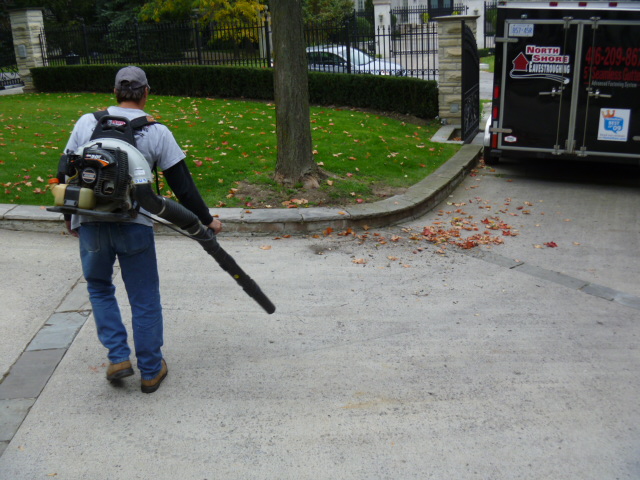
Whether we work in Scarborough, North York or other areas of the GTA, every trailer is equipped with blowers to get your property extra clean. Dirt and shingle grits can all be cleaned up more thoroughly than just sweeping.


Tony having some fun with a back pack blower.


We always inform our clients of what king of parking we require before the project starts. When hiring eavestroughers be aware that they will need a lot of parking space room. It is needed for trucks plus runs 50 or 60 foot pieces of seamless eavestrough. 60 to 70  feet of parking along the front of your property can be needed.


A frequent delivery to our Scarborough headquarters, from one of our aluminum suppliers, Buchner Manufacturing.


See our installers testing out our .023 gauge eavestrough with T-Rex leaf guard. Unless you have a steel roof that is susceptible to snow slides you do not need to go heavier than a .023 gauge eavestrough --unless you expect to have more than 2 people hanging in one spot! If you need more than this don't worry as we have.027 heavy and .032 extra heavy gauge. The good thing about the T-Rex is that it's inexpensive to buy, attaches to the eavestrough before the eavestrough goes on the house reducing labour costs, adds strength to the system, and is widely available to the consumer as most eavestrough companies are using it. By far, the most popular leaf guard on the market.


A view from under the T-Rex leaf guard. The holes are large enough to let in all the water but small enough to keep out downspout clogging debris. The eavestrough will stay free flowing under the leaf guard as anything small enough to go through the holes will wash out the downspouts.


Before T-Rex leaf guard. 


After T-Rex leaf guard (and drip edge because shingles were too short).
We took these pictures at a Toronto home and have seen these same pictures in other eavestrough companies' brochures. Sorry guys, but making these into a mirror image does make them your own! :)


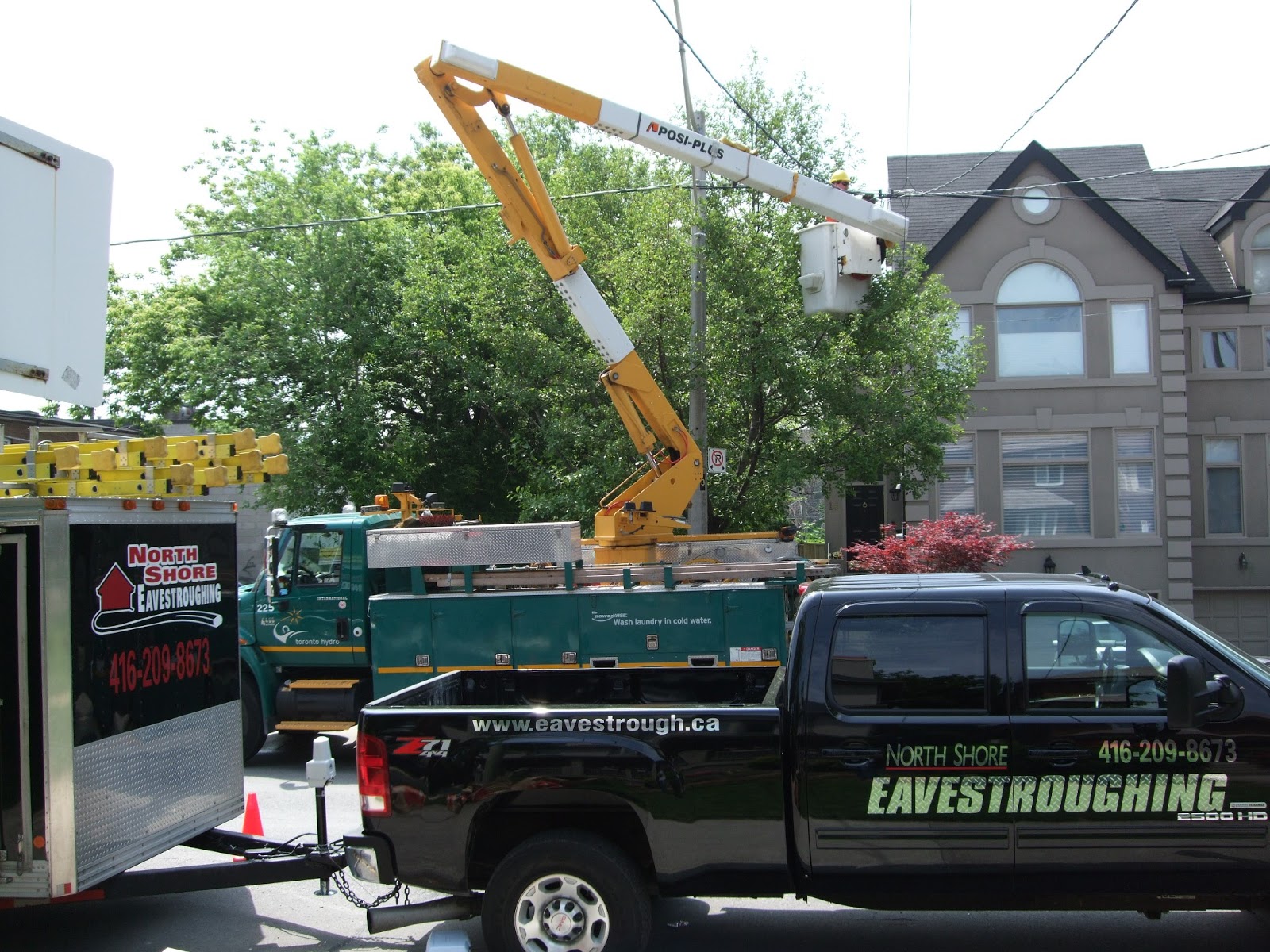
Power lines coming into a home can be deadly. In cases where close proximity or touching of power lines is unavoidable it's best to have the orange line protection installed by Toronto Hydro. This situation is more typical in the downtown Toronto area. It's not cheap (about $600.00 and personally I think Toronto Hydro charges too much and the result is homeowners decide not to have the work done putting workers' lives at risk. You may want to have your lines covered when doing work like roofing, painting, brickwork, or stucco to ensure workers remain safe. The line protection number is 416 542 2618.


You will always see our team using a 4' level to get accurate readings on which way your eavestroughs are sloping. Incorrectly sloped eavestroughs are the number one factor in why eavestroughs overflow. A eavestrough needs to slope down to the downspout. This will move water quickly to the downspout outlet where it can be evacuated from the eavestrough. Proper slopes and large downspouts will allow your eavestroughs to handle these 100 year storms we have just experienced in the GTA. We stand behind our no standing water guarantee and no overflows, no matter how heavy the rain!


A piece of seamless eavestrough with the T-Rex leaf guard installed; did you know that this fastening system is so efficient that you can have this installed as low as $3. per lineal foot when investing in new eavestroughs? It is super strong and resists damage from ladders and the weight of ice and snow.


We treat your home with respect and keep things neat and organized throughout the day.


Visit our website for a free consultation for a new eavestrough system. www.eavestrough.ca